Your Body Doesn’t Treat Light Like Decoration. It Treats It Like a Command.
I used to think energy problems were about effort. Push harder, optimize better, add more tools.
The real issue was timing. Specifically, light timing.
Your nervous system responds to the same light exposure completely differently depending on when it hits your eyes. The 460nm blue wavelength from your phone at 8 AM barely registers as a blip. That same wavelength at 11 PM rewrites your internal clock and suppresses melatonin production for hours.
The light didn’t change. Your sensitivity did.
The Asymmetry You’re Ignoring
Research shows humans are most sensitive to light stimuli during biological night and far less sensitive in the middle of the biological day. The response level shows strong dependency on time of day—large responsiveness at night, low responsiveness during day.
This creates an asymmetry that compounds daily.
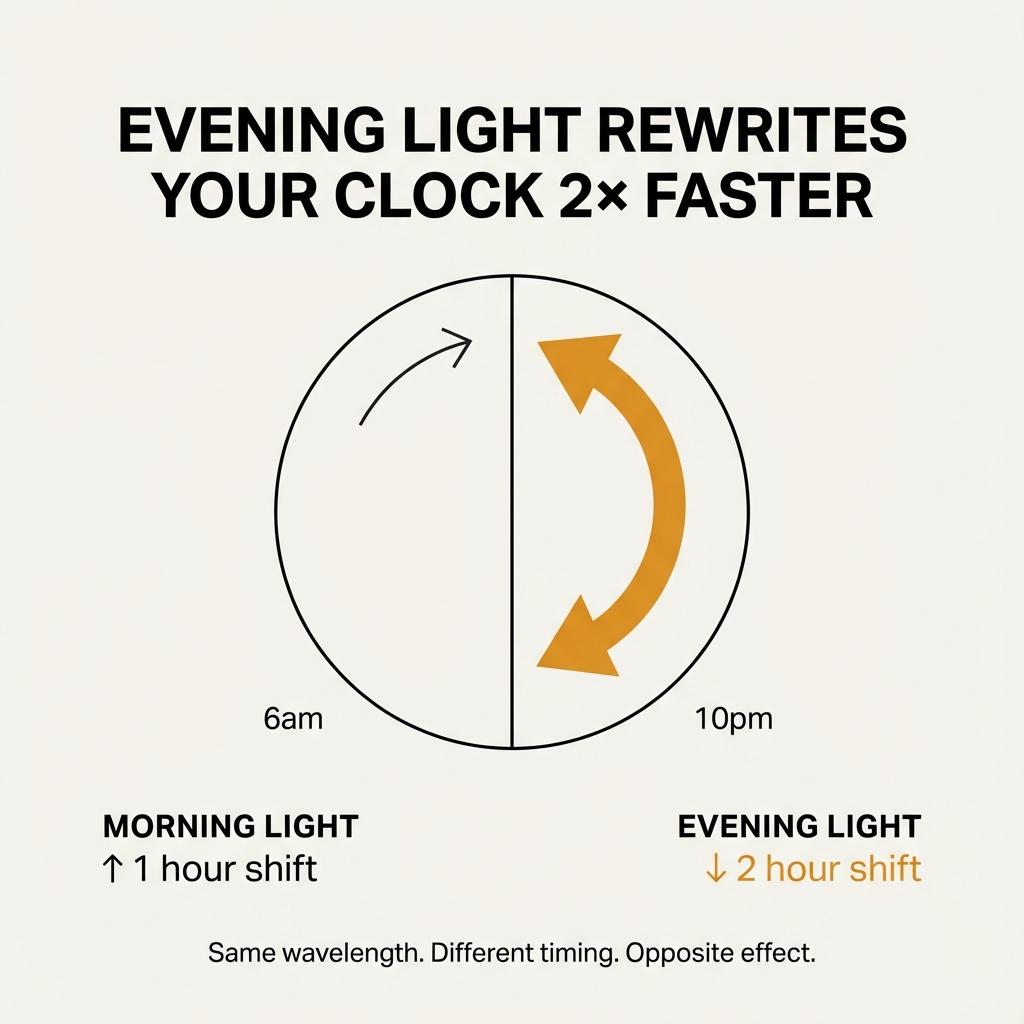
Light exposure in the evening (about 2 hours before and after your usual bedtime) can shift your circadian system roughly 2 hours later per day. Morning light (about 1 hour before and after wake-up) shifts it roughly 1 hour earlier per day.
Evening light doesn’t just interrupt sleep. It actively rewrites your internal clock with double the force of morning light.
When I left corporate work and stopped sitting under overhead office lights for 10 hours daily, my sleep improved dramatically. More natural light meant better life. The problem wasn’t just screens—it was artificial light at the wrong times, all day long.
Blue Light Isn’t the Villain. Timing Is.
Blue light gets blamed for everything. The real story is more specific.
Blue wavelengths (446–477 nm) are the most effective region of the spectrum for suppressing melatonin secretion from your pineal gland. In controlled studies, blue light suppressed melatonin for about twice as long as green light and shifted circadian rhythms by twice as much (3 hours vs. 1.5 hours).
But here’s what matters: wavelength creates the potential for disruption. Timing determines whether that potential becomes actual damage.
Students reading on an LED tablet for 2 hours showed a 55% decrease in melatonin and an average melatonin onset delay of 1.5 hours compared to reading a printed book under low light. This isn’t theoretical. It’s the difference between your body preparing for sleep and your body thinking it’s still midday.
The same tablet at 10 AM? Minimal circadian impact.
Your Eyes Have a Direct Line to Your Clock
You have specialized cells in your retina called intrinsically photosensitive retinal ganglion cells. They bypass your visual processing entirely.
These cells send light information via the retinohypothalamic tract directly to your circadian pacemaker—the suprachiasmatic nucleus of your hypothalamus. They’re wired straight to your internal clock.
This explains why you can “feel” light exposure even when you’re not consciously registering it. Your body is tracking light input as a timing signal, independent of whether you notice the brightness.
When I started watching both sunrise and sunset regularly, my sleep quality improved noticeably. The bookend exposures—bright light early, dimming light late—gave my system clear temporal anchors.
Individual Variability Explains the Confusion
There are very large individual differences in sensitivity of the circadian clock to light. Little is currently known about the genetic basis for these differences.
This is why your partner might scroll at midnight unaffected while the same exposure leaves you wired for hours. Research indicates women have higher sensitivity to the effects of bright light on the circadian system.
Your nervous system also keeps a running history of light exposure. Sensitivity of the SCN neuronal response to short light pulses continuously improves with extended periods of darkness. These response dynamics may represent a cellular correlate of the effects of previous photic history on melatonin suppression.
Yesterday’s screen time affects today’s sensitivity. The system has memory.
Red Light Shows Evening Advantage
When you must use light in the evening, wavelength becomes a strategic choice.
Red light suppresses melatonin initially but allows a significant rebound after 2 and 3 hours, restoring secretion to higher levels. This suggests red light may be beneficial for preserving circadian regulation.
Studies show red light’s circadian-friendly properties work particularly well for females and younger participants, while blue light consistently suppressed melatonin across groups.
The mechanism matters less than the outcome. If you need task lighting after sunset, longer wavelengths create less disruption.
What This Means for Your Daily Structure
Light isn’t neutral. It’s a timing signal your nervous system uses to coordinate when you should be alert and when you should prepare for rest.
The same exposure creates opposite effects depending on circadian phase. You can use this asymmetry as a tool or ignore it and let it work against you.
Morning light exposure: Advances your clock, promotes alertness, supports daytime energy. Front-load bright light early.
Evening light exposure: Delays your clock, suppresses melatonin, extends your wakeful window. Minimize artificial light after sunset, especially blue wavelengths.
When I shifted to getting more natural light during the day—morning sun, midday walks, evening sunset viewing—and reduced artificial light at night, the change was immediate. Better sleep, more stable energy, less afternoon stimulant dependence.
Movement during lunch also reduced my need for afternoon caffeine. Getting outside with fresh air and natural light made my days and nights significantly better.
You Can’t Override This With Willpower
I learned this trying to force sleep through mental effort. Lying awake, mind racing, attempting to think my way into rest.
Deep breathing revealed what I couldn’t see from inside my racing thoughts—I was overstimulated. You can’t think your way down from that state.
Sleep comes through the body. More yoga and exercise. Sweating more. Getting outside with fresh air and natural light. These body-based practices shifted my nervous system into a state where sleep became possible.
Light timing works the same way. You can’t override circadian biology through discipline or intention. You coordinate with it or you fight it.
The Practical Filter
Ask yourself: Am I treating light as decoration or as a signal?
If you’re getting minimal natural light during the day and maximal artificial light at night, you’re sending your nervous system conflicting timing information. The result is the energy volatility you’re trying to fix with more caffeine, better supplements, or optimized sleep hygiene.
The leverage point is simpler than that. Get bright light early. Reduce artificial light late. Let wavelength and timing do the work your willpower can’t.
This is exactly why we built Awaken Rituals around circadian timing rather than stimulation intensity. Our morning coffee is formulated to work with your light-primed alertness phase, not override it. Timing-matched input that reduces negotiation rather than adds another optimization variable.
Your body already knows how to regulate energy across the day. You just need to stop sending it commands that contradict its operating system.