
Caffeine Doesn’t Give You Energy – It Just Blocks the Signal That You’re Tired
I used to think caffeine created energy.
First cup at 4:30am. Another at 8am. One more at 11am. Then the 2-3pm cup to push through the afternoon slump.
The pattern felt productive. The ritual felt necessary. But I was jittery, jumping between tasks, unable to focus on anything for more than a few minutes.
I thought I needed more coffee. Turns out, I needed to understand what coffee actually does.
The Adenosine Parking Lot
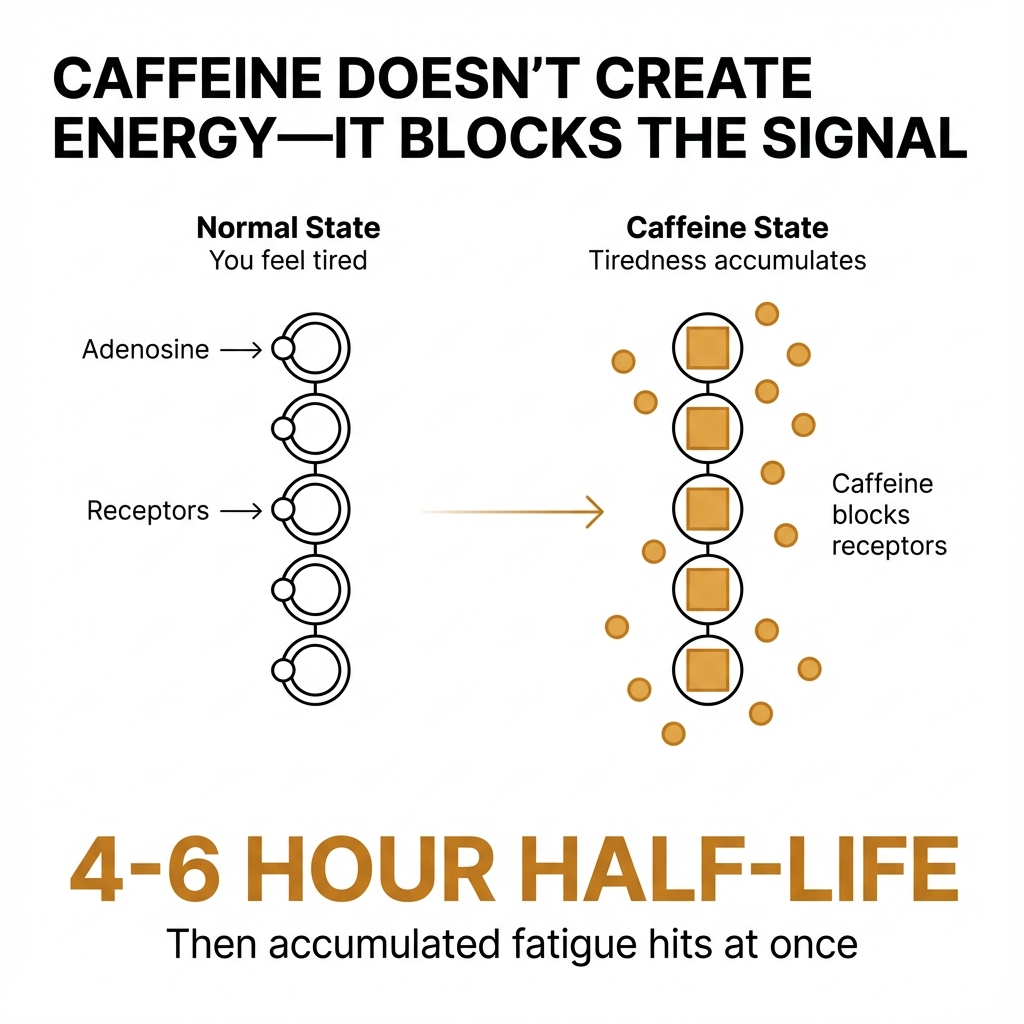
Caffeine doesn’t create energy. It blocks the signal that tells you you’re tired.
Here’s the mechanism: As your brain uses ATP for fuel throughout the day, it produces adenosine as a byproduct. Adenosine accumulates in your brain, building sleep pressure. When adenosine binds to its receptors, you feel drowsy.
Caffeine molecules fit into those same receptors. They occupy the parking spaces adenosine would normally fill.
The tiredness doesn’t disappear – it just can’t deliver its message.
You’re still depleted. You’re still running on yesterday’s sleep and today’s cognitive load. Caffeine just prevents you from feeling it.
The Rebound Effect
Caffeine has a half-life of 4-6 hours. When it wears off, all the adenosine that’s been waiting rushes in at once.
This is why the crash feels worse than the original tiredness. You’re not just tired from the day’s work. You’re experiencing accumulated fatigue that’s been masked for hours, arriving in a concentrated wave.
The rebound is stronger in people who consume caffeine regularly or in large amounts. Your body doesn’t forget what it needs. It just gets the message later, and louder.
Tolerance Isn’t Adaptation – It’s Compensation
When you consume 400-600mg of caffeine daily, your brain responds by producing more adenosine receptors. This is upregulation—your nervous system compensating for constant receptor blockage.
More receptors means you need more caffeine to achieve the same alertness. The mechanism that once worked with one cup now requires three.
But the crash intensity doesn’t diminish.
Receptor density can remain elevated in parts of your brain for 15 days after you stop caffeine. Your forebrain returns to baseline within 8 days, but the adaptation runs deeper than you feel day-to-day.
What Changed for Me
I started doing yoga at lunch. Going for walks. Getting outside during the day instead of chaining myself to a desk under fluorescent lights.
Movement replaced the need for stimulation. I naturally wanted less caffeine after that, and I started reducing.
The jitteriness disappeared. My focus stabilized. I could stay on one task without my attention fracturing every few minutes.
I didn’t realize how much caffeine was costing me until I stopped paying the price.
Timing Matters More Than Amount
Caffeine consumed in the afternoon or evening interferes with adenosine’s role in initiating deep, restorative slow-wave sleep. Even when your total sleep time looks normal, the quality degrades.
Your brain clears waste during deep sleep. It consolidates memories. It resets neural circuits. Caffeine disrupts this process, not by keeping you awake, but by preventing you from reaching the sleep phases that actually restore you.
Evening caffeine – equivalent to a double espresso 3 hours before bed – delays your circadian melatonin rhythm by approximately 40 minutes. That’s nearly half the effect of a 3-hour bright light exposure.
You’re not just losing sleep. You’re shifting your entire internal clock.
The Reset Window
Going caffeine-free for 7-14 days allows adenosine receptor density to return to baseline. Your nervous system recalibrates.
Most people feel the effects within the first week. When you reintroduce caffeine strategically after the reset, it works again.
You don’t need to quit caffeine permanently. You need to understand what it does, respect the mechanism, and use it when timing aligns with your circadian rhythm instead of fighting against it.
What I Do Now
I still drink coffee. But I’m deliberate about when.
Morning light comes first – seeing sunrise anchors my circadian rhythm. Then coffee, after my natural cortisol peak has passed.
No caffeine after noon. The afternoon is for movement, fresh air, natural light. Sweating more. Getting outside.
These shifts made my days and nights significantly better. Not because I optimized caffeine intake, but because I stopped treating stimulation as a solution to misalignment.
Caffeine isn’t the enemy. Using it to override your body’s signals is.
The Real Cost
When you use caffeine to block tiredness instead of addressing why you’re tired, you’re borrowing energy from future availability.
The adenosine builds. The sleep pressure accumulates. The receptors upregulate. You need more stimulation to feel normal, and normal keeps shifting further from baseline.
This isn’t sustainable. It’s extraction.
The alternative is simpler than it sounds: align your stimulation with your circadian phase. Let adenosine do its job. Respect the signal instead of blocking it.
This is why I built Awaken Rituals around timing rather than intensity. Our morning coffee is designed for your circadian wake phase – providing clean stimulation when your body is ready to coordinate with it. Our evening blend removes caffeine entirely, replacing it with compounds that support rather than fight your natural wind-down.
It’s not about drinking more or drinking less. It’s about drinking the right thing at the right time.
Your body knows what it needs. Caffeine just gives you the option to ignore that knowledge temporarily.
The question is whether temporary ignorance serves you, or whether you’re ready to work with your biology instead of against it.
Get started here – and see what happens when your stimulation matches your circadian rhythm instead of fighting it.